Public education matters most when life gets hard.
Not in the headlines. Not in the debates. In the quieter moments.
I am thinking about families trying to keep life steady while everything around them felt uncertain. I am thinking about students trying to stay connected to school when school did not look like school. I am thinking about educators doing the patient work of helping someone learn when the ground kept shifting beneath them.
The last several years clarified something for me. A building does not define education. It is defined by a public promise. When that promise is tested, the real question is whether a system can respond with competence, compassion, and discipline.
That is the idea I keep returning to as I reflect on my time at VLACS and on what comes next for both the school and for me personally. What VLACS represented for students and families during a period of disruption says something important about the future of education and about the kind of leadership that will matter in the years ahead.
What Public Education Is Really About
Public education, at its best, is a commitment to possibility.
It is a commitment that students will not be left alone when life becomes difficult,
unconventional, or uncertain. It is a commitment that learning can continue when
circumstances change. It is a commitment to designing systems for compassion and
rigor, not only for compliance and convenience.
That becomes clearest under pressure.
When routines are intact, many systems can appear functional. The deeper test comes when the normal rhythms of school are interrupted, when students’ lives become more complicated, and when illness, work, anxiety, or family responsibilities make traditional approaches harder to sustain. Those are the moments that reveal what a school is actually built to do.
One of the clearest lessons of the last several years is that educational quality cannot
be judged only by performance under ideal conditions. It must also be judged by
whether a system can keep serving students well when conditions are unstable. It must be judged by whether it can adapt without lowering standards, personalize without weakening rigor, and remain recognizably human while operating at scale.
That is one reason the VLACS model mattered so much during the pandemic. It is also one reason I believe its core design still matters now.
What VLACS Provided When It Was Needed Most
To keep students moving forward, VLACS became a stabilizing force for students, families, districts, and educators across New Hampshire and beyond.
When traditional structures were under strain, VLACS provided continuity. For some students, that meant a full-time school option that could flex around health, work, family responsibilities, or anxiety. For others, it meant a part-time solution that kept credits moving, filled schedule gaps, or preserved academic momentum when in-person attendance became difficult.
Continuity, in that context, was more than logistics. It meant giving students a way to keep learning under the real conditions of their lives and giving families confidence that progress was still possible, meaningful, and supported.
The speed of the response also matters. From June 30, 2020 to June 30, 2021, the student population at VLACS increased by 47 percent. Between July and October of 2020, VLACS hired and trained 125 new instructors. Growth at that scale does not happen by accident. It requires leadership, trust, systems, and people who believe deeply in the mission.
What VLACS showed in that period was clear. Public education can be flexible without becoming fragmented. It can be supportive without becoming vague. It can be student-centered without lowering expectations.
Three Moments I Will Not Forget
Three pandemic-era moments stay with me because they capture the spirit of VLACS.
First, when Commissioner Frank Edelblut asked us to expand our program to serve elementary students, we moved. In July, we began hiring certified and experienced instructors and training them. In August, we opened enrollment for kindergarten through grade three. During the week of August 24, students began working in courses. By November, parents could apply to have their children admitted as full-time VLACS students. In January 2021, the full-time kindergarten through grade five program began.
That is a serious implementation timeline in any year. During a pandemic, it required even more.
Families needed options. They also needed confidence.
One elementary parent described the impact in direct terms. Enrolling her son gave her confidence that he had completed the full grade-level curriculum at a time when the world felt chaotic. I have not forgotten that.
Second, I have not forgotten the families who made clear that what VLACS provided was more than a way to accumulate credit. It provided stability, hope, and forward motion for the family as a whole. Over the years, parents have said the same thing to me: what VLACS did helped not only their child but also their family.
Educational systems do not operate in abstraction. They operate inside real lives. When a school is designed to respond to students as human beings with different circumstances, histories, strengths, barriers, and aspirations, the effects extend beyond transcripts and course completions. They show up in family stability, student confidence, hope, and the ability to keep moving.
Third, I think about how VLACS extended its services beyond its enrolled students by offering free professional development to educators during the pandemic. That decision reflected who we were. When teachers and school leaders across New Hampshire and beyond were being asked to move abruptly into remote learning, VLACS shared what it had learned through years of practice in online education.
Those webinars were practical and generous. They addressed real needs: Zoom instruction, collaborative lessons, communication with remote learners, real-time student support, supervision of remote faculty and staff, and online counseling services. More than 3,500 educators were served through those free professional development efforts during the 2020-2021 period.
What stays with me about that work is the institutional posture behind it. VLACS treated the moment as a public responsibility. We were not simply protecting our own model. We were sharing what we knew so others could better serve students, too.
Those lessons still matter.
Why the Future of Learning Will Change Faster Than Many Expect
The next major shift is already here.
This time, the force driving it is AI. I believe AI will reshape education faster than many people expect.
I do not see AI mainly as a productivity tool or as a tutor that helps students get through assignments faster. It will do both of those things. But that is not the biggest story. I see AI as a teammate, a coach, and a tool that can help educators and students build learning in ways that were previously out of reach.
In the near term, AI will help with tutoring, support, and productivity. That is already happening. The larger shift is that it will give students much more power to shape their own learning while still working within clear expectations and strong standards.
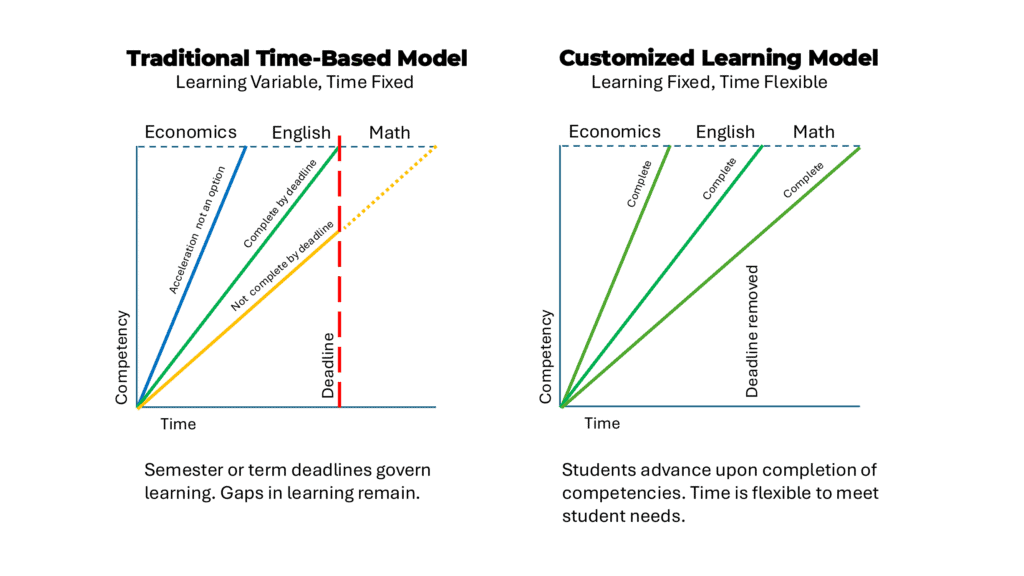
Customized learning means students decide when, where, and how to learn based on their needs, interests, and talents. AI will dramatically expand their power to do exactly that. Rather than relying on one-size-fits-all curriculum, students will increasingly be able to use AI to shape learning experiences that match their readiness, connect to their interests, and align with required competencies. It will make it easier for students to design projects around questions that matter to them, move at an appropriate pace, and learn in ways that work best for them while staying within strong academic expectations and clear standards. That is the real promise here: AI can help make customized, adaptive, standards-aligned learning a practical reality for every student.
AI will also strengthen students’ ability to connect learning to the real world. A student interested in nursing, construction, design, software, hospitality, entrepreneurship, aviation, media, or the trades will be able to use AI to identify opportunities, prepare for conversations with mentors, map next steps, and connect schoolwork to real-world experience in far more meaningful ways. Students will be able to test business ideas, refine inventions, explore problems worth solving, and move from vague interest to purposeful action with greater confidence.
That has major implications for the structure of school itself.
For a long time, schools have had little choice but to package learning into fixed courses, fixed pacing, fixed materials, and fixed sequences. That made sense in another era. But if students can increasingly use AI to generate aligned and responsive instruction, feedback, practice, application, and extension work, then static, one-size-fits-all courses may no longer need to sit at the center of the system. Students may move more fluidly between academic study and real-world application. They may spend less time moving lockstep through a standard course and more time working through
learning experiences built around competencies, goals, interests, talents, and
performance.
That is a major shift.
It also raises the stakes for educators.
The job ahead is not to stand between students and AI. The job is to help students learn how to work with it wisely. Students will need to know how to question it, guide it, improve it, test ideas with it, and use it as a serious partner in learning and creation. They will also need to know how to use it without letting it become a shortcut around thinking, effort, judgment, or integrity. They will need adults who can help them tell the difference between convenience and quality, between speed and understanding, and
between what can be done and what should be done.
Education has a long history of absorbing change slowly. There are reasons for that. Institutions are built to provide stability. Systems are shaped by habit, policy, funding, and public expectation. I understand that. But educators cannot afford to wait for perfect clarity before acting. It is our responsibility to prepare students for the future they are entering, not the past we are most comfortable managing.
Schools should also resist a familiar mistake. A new tool appears, schools fit it into established routines, and the larger opportunity gets reduced to a more efficient version of the old model. That is a real risk here. If AI is used only to support traditional assignments, pacing, course structures, and compliance, schools may preserve the system while missing the opportunity. The larger opportunity is to ask what kind of model best leverages what AI and customized learning now make possible.
Why I Remain Confident in the VLACS Model
That is one reason I remain confident about the VLACS model.
VLACS was built for a world where path, pace, place, and purpose can flex. It was built on the belief that learning can be personalized without lowering standards. It was built on the understanding that not all students need the same route to meet the same high expectations. It was built on the idea that relationships matter. That combination gave VLACS strength during the pandemic, and it provides a strong foundation for what comes next.
But none of that happened by accident.
VLACS began with a question, and SAU 16 Superintendent Arthur ‘Skip’ Hanson dared to ask it: What if school could be designed differently so that more students could succeed?
That question still matters.
It challenged traditional assumptions about where learning happens, how progress is measured, and what public education could look like if it were built more intentionally around students. It opened the door to innovation. It created room for a different model. Skip believed in that model before many others did, and he gave me the chance to help build something different. I remain deeply grateful to him for that.
In some ways, we are at that point again. We need the courage to rethink old
assumptions about time, pace, place, and path. We need the discipline to design models that fit the future students are entering, not only the system we inherited.
That willingness to challenge assumptions, then build carefully and responsibly in response, has always been part of the VLACS story. I hope it remains part of its future as well.
A Leadership Transition
I also want to share a leadership update.
I will be retiring on March 31st as CEO of VLACS. On April 1, 2026, Natalie Berger, currently Chief Operating Officer, will become the next CEO of VLACS.
I could not feel better about that.
Natalie knows VLACS well. She understands the mission, the model, and the people. She joined VLACS with the second cohort of instructors on July 1, 2008, and she has been part of the growth, the thinking, the problem-solving, and the steady work that brought the school to where it is today.
She is creative. She is caring. She is thoughtful. She has a strong sense of humor, which matters more in leadership than people sometimes admit. She also understands that a school like VLACS has to keep thinking, keep adapting, and keep holding tightly to its purpose.
Just as important, Natalie understands that VLACS is not simply a structure or a system. It is a school built on relationships, high expectations, flexibility, and belief in students. I have great confidence in her leadership, and I am excited about the future of VLACS under her direction.
My Next Chapter
My next chapter will center on my creative passion: photography. And, if the right opportunity comes along, it may also include a continued connection to innovation in learning.
Before I close, I want to thank a few people directly.
Gratitude for the People Who Built This
Thank you to the students and families who trusted VLACS, shared their stories, challenged us to improve, and reminded us what this work is really about.
Thank you to the instructors, advisors, leaders, and staff who built this school day by day. The strength of VLACS has always come from the people doing the work.
Thank you to our school partners, career mentors, supporters, and members of the broader education community who believed in the model and helped expand what was possible for students.
Thank you to the VLACS Board of Trustees. Their stewardship, governance, and commitment to the mission helped guide the organization through years of growth, innovation, and change. Their willingness to support new ideas, ask hard questions, and keep students at the center of the work made a real difference.
And thank you again to Arthur ‘Skip’ Hanson. Your leadership, your support, your partnership, and your belief in this work mattered more than I can say.
I leave this role with deep gratitude.
If we worked together, learned together, built together, or crossed paths somewhere along the VLACS journey, thank you. It has been meaningful work. Important work. Hopeful work.
I believe VLACS made a real difference when New Hampshire needed it.
I believe VLACS is well-positioned for the future of learning.
The promise at the center of public education is still worth keeping.
Steve
Instagram: @skossphoto
Facebook: https://www.facebook.com/skossphoto
Linkedin: www.linkedin.com/in/steve-kossakoski